

For over 28,000 properties across the Capital Regional District (CRD) — including many homes in Saanich, Sooke, Metchosin, and the Highlands — public sewers aren’t available. Instead, these households rely on private, on-site septic systems. These systems act as highly efficient, natural micro-treatment plants right in your backyard. Think of a septic system as your property’s personal, underground wastewater recycling plant. It works completely off-grid, using gravity and natural bacteria to separate solids and break down waste entirely out of sight. Once the water is safely filtered, it quietly trickles back into the ground to recharge the local water table, making it a highly efficient, self-sustaining utility for your home.
Understanding how a septic system operates is the first step to keeping it running smoothly and protecting our beautiful coastal environment.
The Two-Step Natural Treatment Process
A standard residential septic system uses a combination of basic physics and natural biology to clean water through two distinct stages:
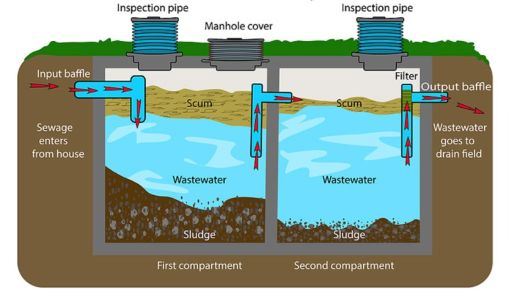
- The Separation Stage (The Tank): All wastewater from your house travels into a buried, watertight concrete or fiberglass tank. Here, the mixture sits for several days. Heavy solids sink to the bottom to form a layer of sludge, while lighter materials like fats, cooking oils, and grease float to the top to form scum. In the middle remains a layer of relatively clear liquid called effluent. Inside the tank, invisible anaerobic bacteria (microbes that live without oxygen) eat and break down the solid waste.
- The Filtration Stage (The Drain field): As new water enters the tank, the middle layer of clear effluent is pushed out through a filter and into the drain field (or absorption area). This area consists of a network of perforated, underground pipes nestled in gravel trenches. The effluent slowly trickles out of the pipe holes and filters down through the gravel and native soil.
As the water passes through the ground, natural aerobic bacteria (microbes that need oxygen) and soil particles destroy remaining viruses, harmful bacteria, and excess nutrients. By the time the water reaches local groundwater, it is completely purified.
Staying ‘Septic Savvy’ in Victoria
Because these systems rely entirely on a delicate balance of biology and soil filtration, they require regular attention. Under provincial law and CRD Bylaw 3479, homeowners are legally required to maintain their septic systems.
As a rule of thumb, standard gravity-fed systems (Type 1) should be inspected and pumped out every 2 to 5 years by a Registered Onsite Wastewater Practitioner (ROWP) to prevent solid sludge from clogging the drainfield. Advanced treatment systems (Type 2 and 3) must be maintained annually.
To protect your backyard investment, avoid flushing harsh chemical cleaners, medications, or grease down the drain, as they kill the beneficial bacteria your tank relies on. Additionally, never park cars or construct buildings over your drain field, as compacting the soil will ruin its ability to filter water. With a little care, a local septic system can safely protect your wallet and Victoria’s ecosystem for decades.
Questions to Ask When Buying a Property that uses a Septic System
To find out exactly how a home’s septic system is performing before you buy, here are some questions to ask the seller’s realtor:
Q. Where is the official documentation for the system?
- Request the original installation permit, the system layout map, and the filing documents submitted to Island Health or the Applied Science Technologists and Technicians of BC (ASTTBC).
- Why it matters: You need to know the exact location of the tank and drain field, so you don’t accidentally build over them or drive over them.
Q. When was the tank last pumped and inspected?
- Request the maintenance records and pumping receipts from the last five years, and who was the Registered Onsite Wastewater Practitioner (ROWP) that serviced it.
- Why it matters: Under CRD rules, standard tanks should be pumped every 2 to 5 years. If the seller cannot produce a recent receipt, the system may have been neglected.
Q. What type of system is installed, and what is its daily capacity?
- Is the septic system a standard Type 1 gravity system, or an advanced Type 2 or 3 treatment system, and how many bedrooms is it legally rated to support?
- Why it matters: Advanced systems require mandatory annual maintenance contracts. Furthermore, if the system is rated for a 3-bedroom house but the seller added a 4th bedroom, the system will be overloaded and fail.
Q. Have there been any recent backups, slow drains, or soggy areas in the yard?
- Ask if the seller has ever experienced pooling water over the drain field, foul odours, slow-draining toilets, or plumbing backups during heavy Victoria rains.
- Why it matters: These are classic warning signs that a drainfield is clogged or failing, which can cost tens of thousands of dollars to completely replace.
Q. Will the seller agree to a professional septic inspection as a condition of sale?
- Will the seller permit a certified ROWP to perform a full camera inspection and load test of the system before closing, and when was the last time the tank effluent filter was cleaned?
- Why it matters: A standard home inspector does not thoroughly check septic systems. You must protect yourself by making the sale conditional on a clean bill of health from a specialized septic professional.