

A Changing Real Estate Market, the Interest Rate Question, and Why We’re Optimistic About Victoria
Well, September certainly gave us something to think about. After a surprisingly strong August, when Greater Victoria recorded its best August home sales numbers in five years, the market slowed considerably. Real Estate Sales declined, listings increased, and according to the Victoria Real Estate Board, September marked our first buyer’s market in more than a decade, excluding the unusual conditions at the beginning of the pandemic.
That might make some homeowners nervous, but we don’t necessarily see it as cause for concern. In fact, for home buyers, this could be one of the better opportunities we’ve seen in quite a while.
There’s also plenty happening beyond our local market, particularly with interest rates, government borrowing costs, and the Bank of Canada’s next rate announcement on October 28.
Here’s our perspective on what it all means for Victoria..
September Brings a Shift Toward Buyers
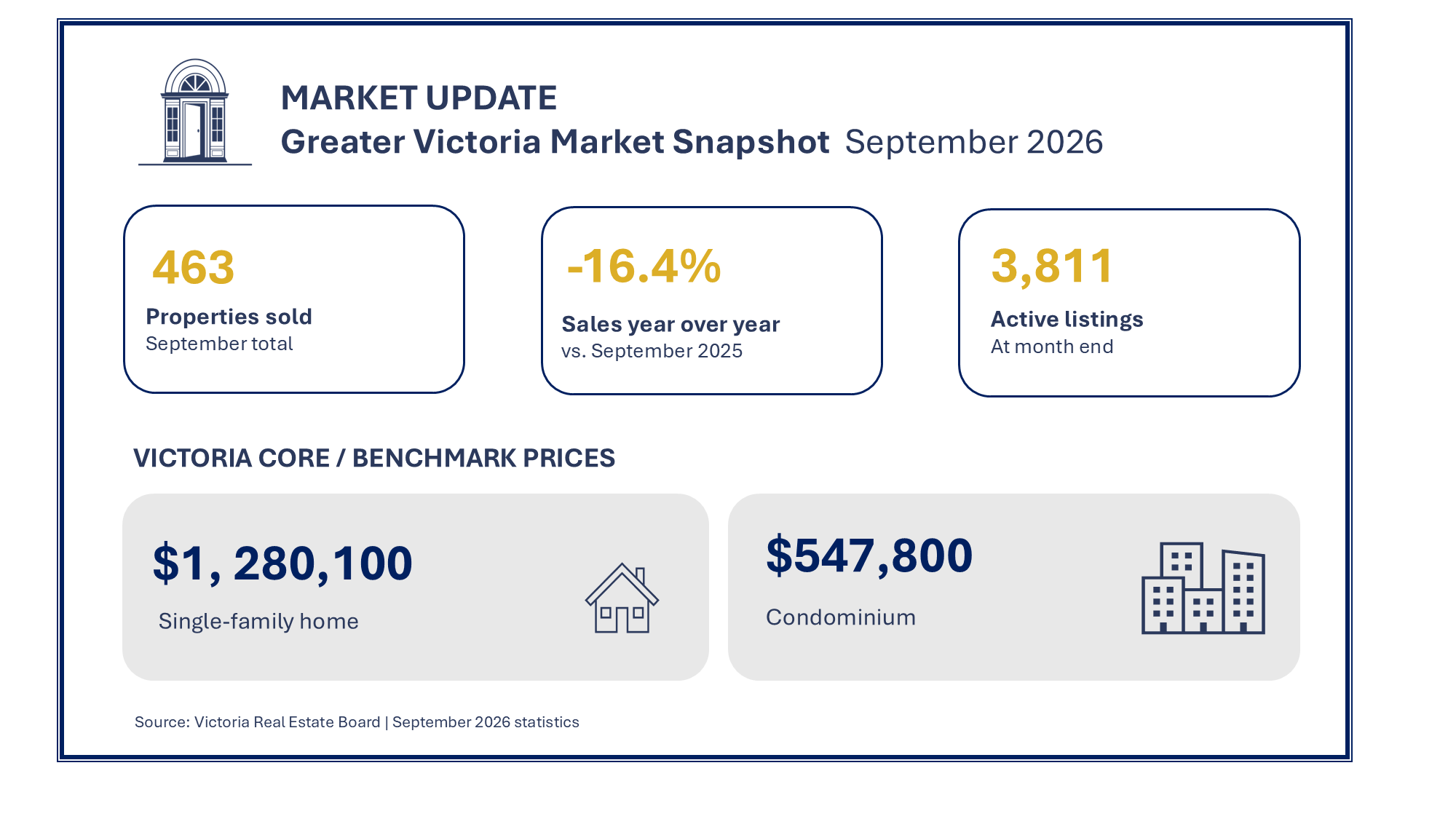
The most notable change was the shift in market conditions. Excluding the unusual circumstances at the beginning of the pandemic, September marked the first time Victoria entered buyer’s-market territory since January 2015. However, since July and August were considerably stronger, we’ll need more time to determine whether September represents a lasting shift.
For buyers, the change is welcome. There’s more selection, more time to make decisions, and greater negotiating power.
For sellers, it means adjusting expectations. Homes are still selling, but buyers are paying closer attention to condition, location, and value. Pricing appropriately from the outset has become particularly important. Anecdotally, we’re still seeing well-priced homes in good condition sell quickly and are even seeing multiple offer situations.
Home Prices Are Holding Up
Despite slower sales, benchmark prices have been relatively stable.
The benchmark price for a single-family home in the Victoria Core was $1,280,100 in September, just 2% below last year. Condominiums increased 1% to $547,800, while the townhouse benchmark was $829,400.
Across the broader region, the single-family benchmark was $1,150,300, approximately 1.5% below September 2025.
These figures suggest that although fewer properties are changing hands, we haven’t seen a corresponding decline in prices across the board.
Of course, individual neighbourhoods and property types can tell very different stories. A downtown condominium, a family home in Saanich, and a waterfront property in Oak Bay operate in quite different markets. Regional averages only tell us so much.
Why We Remain Optimistic About Victoria
We admit we’re a little biased, but we think Victoria has some compelling long-term advantages that are easy to overlook when the monthly market statistics dominate the headlines.
The lifestyle is an obvious one. Our mild climate, coastline, established neighbourhoods, and access to the outdoors continue to attract people from across Canada.
But there are also some interesting demographic and economic fundamentals.
Greater Victoria’s population grew 8% between 2016 and 2021, slightly faster than Metro Vancouver. Looking ahead, the provincial government projects that the Capital Regional District will grow from approximately 460,000 residents in 2024 to 524,000 by 2046.
If those projections hold, our region will need to accommodate another 64,000 residents over the next two decades.
Victoria also benefits from a relatively diverse employment base. Provincial government, healthcare, education, technology, tourism, and the military all contribute to the local economy. Healthcare, public administration, and retail together accounted for approximately 41% of employment in 2021.
Our demographics are interesting too. Approximately 23% of Greater Victoria residents were aged 65 or older in 2021, compared with 20% provincially. That helps explain the importance of retirement and downsizing in our market, particularly demand for condominiums, townhouses, and homes with more accessible layouts.
And despite significant interest-rate increases and economic uncertainty, benchmark prices remain above their September 2021 levels. Across the region, single-family homes are up approximately 5.6%, condominiums 7.5%, and townhouses 9.6% over that period.
Those aren’t extraordinary returns, particularly after accounting for inflation, but they do suggest that benchmark property values have held up reasonably well despite higher borrowing costs and considerable economic uncertainty.
There are certainly headwinds. Affordability remains difficult, population growth has slowed, and Victoria’s purpose-built rental vacancy rate reached 3.3% in 2025, its highest level since 1999.
We wouldn’t suggest Victoria is immune to economic pressures or that prices can’t decline. But we think it’s important to distinguish between a market having a strong year and one with attractive long-term fundamentals.
Victoria’s combination of lifestyle, established communities, economic diversity, and long-term housing demand continues to make it one of Canada’s most appealing places to own a home.
And many of the people we meet who are moving here aren’t simply looking for an investment. They’re looking for somewhere they genuinely want to spend the next chapter of their lives.
Canada, the U.S., and the Interest Rate Question
We’ve been following developments in the American economy closely, particularly concerns surrounding U.S. government debt and their potential implications for interest rates.
As of early October, the Bank of Canada’s overnight rate is 2.25%, compared with the U.S. Federal Reserve’s 3.75%–4.00%.
That’s a substantial difference between two closely connected economies.
The difference largely reflects the economic and inflation conditions facing each country. Canada also benefits from a comparatively favourable government debt position and strong sovereign credit ratings, which can influence government borrowing costs and, indirectly, mortgage rates.
Canada maintains AAA ratings from Moody’s, Standard & Poor’s, and DBRS Morningstar, while Fitch rates Canada AA+. The United States has experienced downgrades from all three major international rating agencies, most recently Moody’s in May 2025.
According to IMF estimates cited by Canada’s Department of Finance, Canada has the lowest general government net debt-to-GDP ratio in the G7, although that measure differs from the more commonly reported gross government debt figures.
Why does this matter for homeowners?
Government borrowing costs influence interest rates throughout the economy. Canadian fixed mortgage rates are particularly sensitive to Government of Canada bond yields, especially the five-year bond.
Although Canada’s financial position is comparatively strong, our bond market remains closely connected to the United States. Higher American borrowing costs can therefore affect Canadian mortgage rates.
In fact, Bank of Canada research published earlier this year found that Canadian and American long-term bond risk premiums have moved remarkably closely together.
The takeaway? Canada’s financial position provides some advantages, but we’re not insulated from developments south of the border.
And when it comes to mortgages, the Bank of Canada’s overnight rate is only part of the picture. Bond markets matter too.
What Happens on October 28?
The Bank of Canada’s next interest-rate announcement is October 28.
The Bank has held its overnight rate at 2.25% since October 2025. Although further reductions had previously been anticipated by some economists, persistent inflation and higher energy prices have complicated the outlook.
The challenge is balancing inflation against relatively weak economic growth.
In its September announcement, the Bank noted that headline inflation had been hovering around 3%, largely because of higher gasoline prices. Excluding gasoline, July inflation was 2.2%, although persistent energy costs and trade uncertainty remain concerns.
The Bank’s next decision will depend on whether inflationary pressures continue to outweigh concerns about economic growth.
For anyone considering buying a home, we’d caution against making decisions based entirely on predictions about interest rates.
We’ve seen buyers wait for lower rates, only to face greater competition when confidence returns. We’ve also seen people rush into purchases because they fear rates might increase. Neither approach is ideal.
What matters more is finding the right property at a fair price and ensuring the financing works for your circumstances. And there’s something worth remembering about today’s market: buyers have more negotiating power than they’ve had in years.
A slightly lower mortgage rate would certainly be welcome, but so is having more choice and negotiating without competing against multiple offers. Often the opportunity is in the purchase price rather than the interest rate.
Looking Ahead
As we head toward winter, we’ll be watching whether September’s slower activity continues and how inventory changes.
Historically, available listings decline toward year-end. If that happens again, it could shift the balance between buyers and sellers.
For sellers, this is a time to be realistic and well prepared. Properly priced, well-presented homes can still attract strong interest. Buyers are also paying closer attention to maintenance and condition, so those small repairs you’ve been putting off are worth addressing before listing.
For buyers, there’s an opportunity to explore different neighbourhoods, take your time, and potentially negotiate a purchase without the pressure we’ve seen in previous years.
And for homeowners who aren’t planning to move, there’s little reason to get caught up in every monthly statistic.
We remain positive about Greater Victoria, not because we expect prices to rise every year, but because the underlying reasons people want to live here remain compelling.
As always, if you’re wondering what the changing market means for your property, considering a move, or simply curious about your neighbourhood, we’d be happy to hear from you.
Sometimes a conversation over coffee is more useful than another real estate headline.
Enjoy the beautiful fall weather, and we hope to see you soon!
Warmly,
Audra & Robert
The Victoria Pros Real Estate Team
For more statistics on the Victoria real estate market – click on the links in the following boxes for the latest reports and data from the Victoria Real Estate Board, the British Columbia Real Estate Association, the Canadian Mortgage and Housing Corporation and the Canadian Real Estate Association.

Victoria Real Estate Monthly Statistics
BC Real Estate Association Housing Market Update
Canadian Mortgage and Housing Corporation